Filmmaker-first positioning
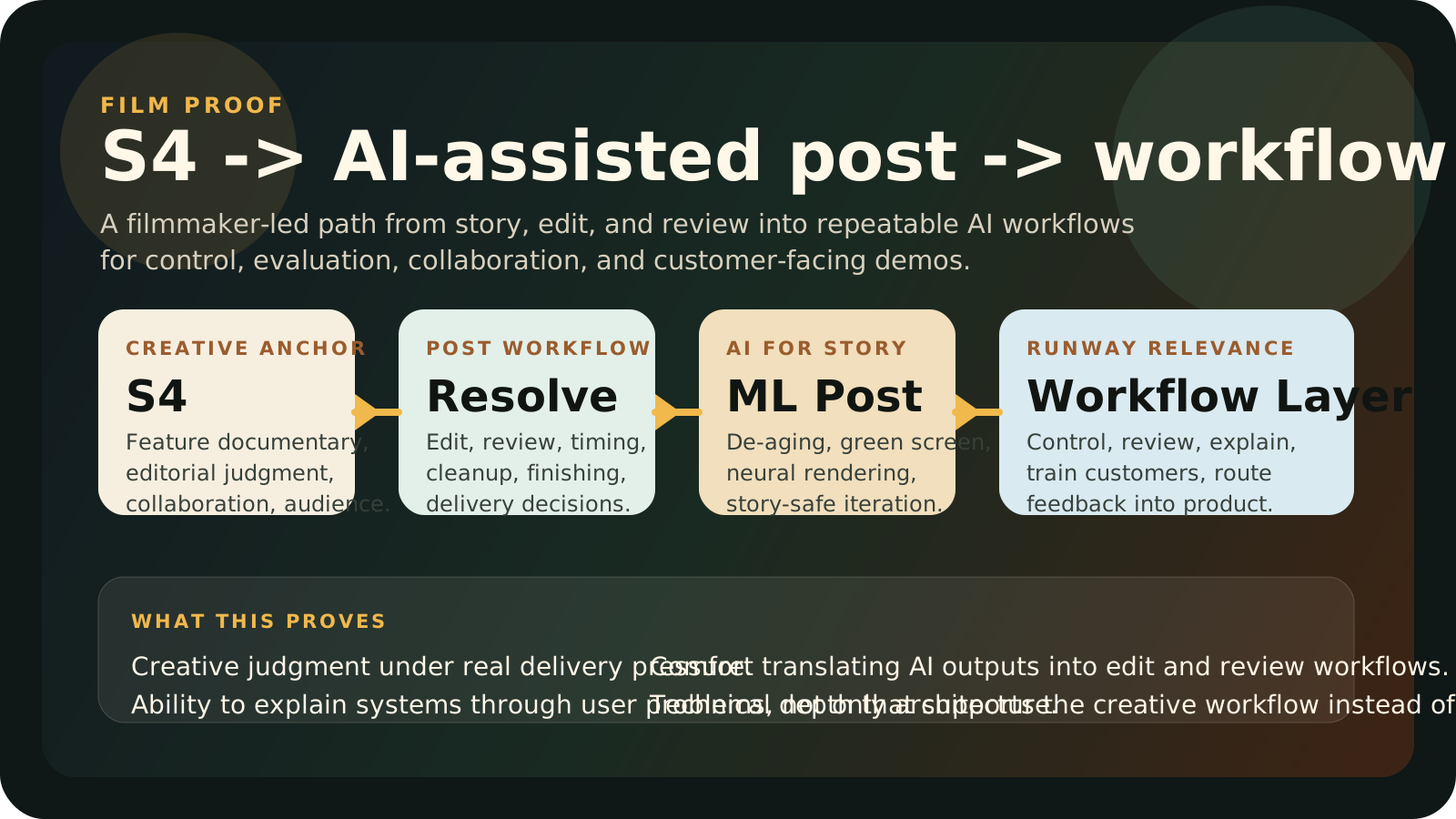
S4 is the creative proof behind the workflow story.
S4 is a released feature documentary, and the useful AI question was never "can I generate something?" It was whether a de-aging pass held up once intercut, whether green-screen cleanup preserved edges and motion, and whether a neural-rendered option still survived timing, review, and grade inside a real post workflow.
What this looked like in post.
The technical repos matter more when they are read as extensions of actual post-production judgment: what survives the cut, what breaks continuity, what stays editable, and what is not worth forcing into the timeline.
A de-aging pass is only useful if it still reads naturally once intercut with surrounding shots and performances.
Green-screen or background cleanup only matters if edges, motion, and compositing hold up under review instead of creating a new post problem.
A neural-rendered option has to stay usable after timing, notes, and grade, not just look interesting in isolation.
DaVinci Resolve is where those decisions become concrete because edit rhythm, review notes, and delivery constraints all meet there.
AI-assisted post workflow.
The workflow starts from the scene problem, not from the novelty of the model. That same instinct carries into the rest of the portfolio and into how I would demo or teach the tools.
- Start with the story problem: what the cut needs, what continuity must hold, and what emotional effect has to survive.
- Review reference frames, edit timing, and finishing constraints inside a practical post-production workflow.
- Use AI only where it reduces friction: de-aging, green screen cleanup, background work, or neural rendering.
- Compare results against story, editability, continuity, and delivery quality instead of treating the output as automatically usable.
- Keep what serves the scene and discard what behaves like a flashy but unreliable detour.
What this proves for Runway.
The role needs someone who can explain tools to creative teams, structure demos around real user problems, and judge whether output actually supports the brief.
| Signal | Why it matters |
|---|---|
| Filmmaking and documentary production | Shows end-to-end creative judgment rather than only technical experimentation. |
| Editorial and finishing habits | Shows comfort with the real environment where AI outputs must survive review and delivery. |
| AI-assisted post decisions | Shows a bias toward workflow usefulness over novelty, which is central to enterprise adoption. |
| Technical depth under the hood | Shows the ability to build custom control, review, evaluation, and deployment layers when customers need more than defaults. |
Public Proof Slots.
The next portfolio upgrade is approved media. Until those assets are ready, the portfolio now has canonical file paths for the still, timeline screenshot, GIF, and final reel, and a public walkthrough page already points to the same recording slot.
 Still placeholder
A designed stand-in for the approved S4 still or poster frame.
 Timeline placeholder
A stand-in for the eventual DaVinci Resolve screenshot proving editorial reality.
 Reel placeholder
A forwardable poster surface until the real recording replaces it.
Reserved for the first approved S4 still, poster frame, or filmmaker-first image that anchors the story.
Reserved for one safe DaVinci Resolve screenshot that proves real editorial process without exposing anything private.
Reserved for the fastest-scanning public workflow proof on GitHub, the portfolio, and short recruiter surfaces.
Reserved for the final 60 to 90 second film-first walkthrough once one approved cut is ready to publish.
How the repos extend the film story.
The supporting projects are stronger when they are read as workflow extensions of the creative anchor rather than as standalone research artifacts.
Explores how director-style intent becomes controllable generation inputs.
Explores how teams inspect spatial assets before committing to animation or generated shots.
Explores how review notes become explicit creative QA instead of taste-only debate.
Explores what happens when a creative workflow has to scale, route, and stay reliable.
"My starting point is filmmaking. The technical work matters because it helps creative teams generate, review, evaluate, and deliver work under real production constraints."